The Paradigm Shift in Refined Products Terminal Management


For the past 20 years, terminal management software has not changed.
And this was for good reason, the software did what it needed to do. But we have now embarked on a new era of bulk liquids terminal management software, starting for the refined products sector.
The legacy terminal management software model:
Product feature releases very sporadically, if ever. This is positive to operations continuity but extremely detrimental to long-term R&D and further efficiency gains via software
Software support handled by the terminal operator
Large refined products terminal operators would hire employees from vendors in house to support the software. This works until it doesn’t as it is shortsighted on future talent development and more importantly, it cuts off product innovation
When a vendor supports their own software, they can help the feature set evolve in a productive way for their customers
A more extreme version of this is operators building their own software, which over the past 5-10 years, has proven highly costly (huge budget overruns) and mostly unsuccessful. It also plants a landmine for the future
No real-time standard data set of terminal customers, products, liftings
Examples: non-standard product codes, entering driver/carrier data into every TMS
The legacy software prioritized proper load authorization and BOL generation. This is a feature now and no longer a separate product
Data may be moved into a central database from individual site servers, but not in real-time or in a normalized way
Terminal management software stopping at rack control (mainly for truck loading) and inventory management
Back office processes for the terminal and corporate level are largely handled in spreadsheets and manual workflows
A wider purview and rapid product innovation
During this time period, Dearman Systems was servicing refined products operators but also NGL, crude, chemical, and ethanol plants. This gave our company a wider purview on operational processes.
Additionally, Les Dearman, the founder of Dearman Systems who left the company in 2020 when it was acquired, was always interested in adding custom features for his clients around loading processes, PLC integrations, rail movements, marine movements, and integrations.
For the Version 4 Dearman TAS, this interest in adding custom features had pros and cons. It increased customer automation levels and productivity on the up side. It added complexity for customer support and deployments on the down side. As you will read further on, Version 5, released last year and now being installed with customers at a rapid rate, productizes all of these customizations into a full featured, standardized platform that handles truck, rail, marine, and pipeline movements from point of demand, to loading/unloading, to BOL generation, invoicing and ERP/ETRM integration.
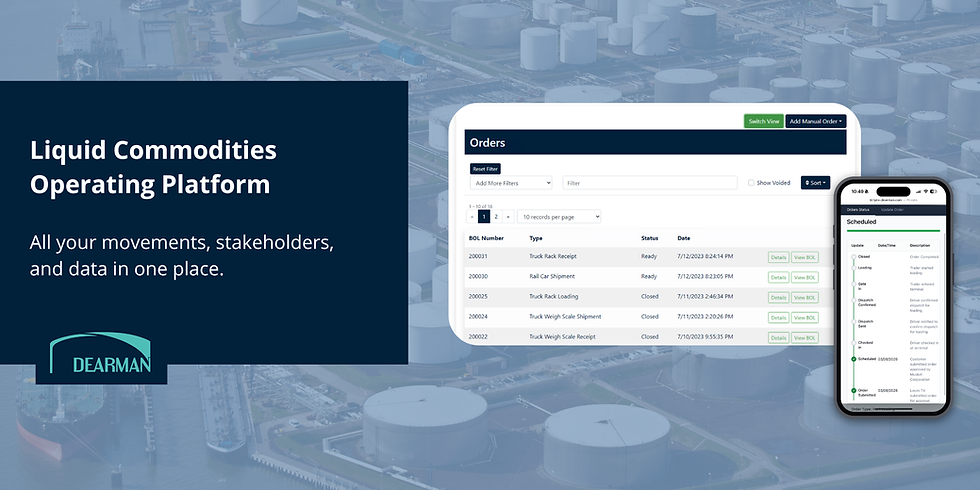
One of the biggest product innovations, which is just now becoming globally predominant, is the real-time data hub (UNITY) for all your terminals, movements, and data to be in one database in real-time. This product is one of the key IP advantages of the Dearman Liquid Commodities Logistics Platform that is in the market today.
So what? What do these features get me if I’m the executive team or a shareholder?
Ok so that’s great – Dearman software has a lot of features and integration capability. So what?
Here’s the kicker…these features allow 3rd party terminals to operate at a lower cost structure while actually delivering a better customer experience. This isn’t theoretically possible, it is happening today.
"...these features allow 3rd party terminals to operate at a lower cost structure while actually delivering a better customer experience"
In a competitive market, this means terminals who move to the Dearman platform will increase EBITDA while actually lowering customer fees. Those who are slow to move may lose customers…
Since this sounds too good to be true, here is a few ways the cost savings happens (mainly via back office automation):
UNITY allows carrier/driver management across all terminals from one database
Accounting integration at UNITY level means no entry of data to accounting systems
Automated invoice generation (for any fee type) can be natively reviewed and sent
Ability to pre-dispatch trucks
Truck traffic management app for busy terminals
Railcar loading checklists, unit/manifest orders, and staged rail handling
SaaS Customer portal for all nominations, movements (truck, rail, marine, pipeline) and administrative data (customers, destinations, etc)
Self-service position holder reporting, movement completion tracking and BOL access (customer service automation)
Automated ExSTARS reporting directly to the IRS
ETRM integration if taking title (first and third party operator)
The list goes on (it was honed over a 20 year period after all). And the OPEX savings are in the millions to tens of millions of dollars per operator.
The new paradigm for terminal management is: Demand to rack processing to invoice automation
The new paradigm is the Liquid Commodities Logistics Platform implemented and supported by Dearman Systems. This is the new best-in-class terminal management software that will define the next decade, both in North America and beyond.
Notes:
Dearman has many more software and hardware integrations in production than any other terminal software vendor
For V5, by standardized platform, we may a single code base with feature flags
Lower terminal costs means lower prices at the pump, something Dearman is proud to enable
Dearman staffs an electrical engineering team with expertise in Acculoads, Multiloads, and Modbus
Our Tucson-based customer support team is world-class